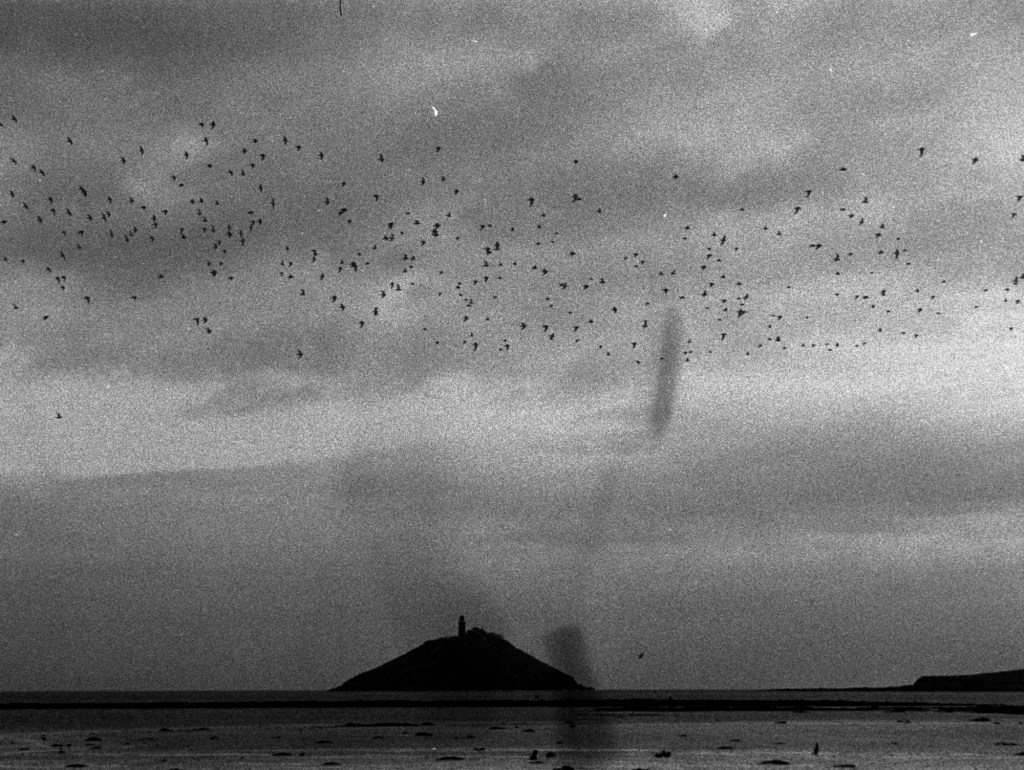
Today is February 20 and it is raining in Dublin. Sometimes it’s worth stopping and asking, for how long? Was the sky ever blue, or has it always been this oppressive shade of gray? Rain is such an ingrained part of Irish life that it has seeped into the fabric of the island’s culture. An old adage claims that the Irish language holds 99 words for rain, and that might be correct. In the pluvial lexicon, the Irish are well equipped.
The Irish Times recently catalogued Irish weather-related words, coined over the years by “néaladóirí (cloud-watchers), réadóirí (stargazers) and fiachairí (those who observe ravens for signs of weather change). Their findings include such wonderfully descriptive terms as: rilleadh báistí (streaming rain, like oats through a riddle), dallcairt (raining so heavily you cannot see ahead), and gleidearnach (a war-like downpour). Ancient Celts understood the forecasting capabilities of birds, insects and fish, and incorporated them in adages like Dea-shíon an spideog ar bharr na gcrann (Good weather when the robin is high on the branches). In traditional knowledge the behavior of seals, the sheen of light on the ocean’s surface, and the texture of the sand could all serve as indicators of rain.
Life under a moody clime has a way of shaping people’s attitudes. On the rain-beaten shores of Ireland, the icy streets of Montréal, and the snow-buried kominkas of Hokkaido are bound by a shared affinity for humor, community and resilience. When people are forced indoors, they tend to find creative ways to get along. With storms come movie marathons, feasts, parties, booze and, inevitably, stories – rainstorms, in storytelling, are both catalyst and subject. As an Irish phrase says, Is maith an scéalaí an aimsir (Weather is a good storyteller).
On January 6, 1839, Ireland was celebrating Little Christmas, the original date of Christmas Day prior to the Gregorian calendar. It was the Twelfth Night of Christmas, known to some as “when the dead walk.” In the night, a massive weather system of hurricane-force winds over 100 miles per hour slammed the Irish coast. Trees were uprooted. Houses were flattened. Forty-two ships were wrecked. Hundreds of people lost their lives. The countryside was devastated, “black,” it was said, “with the mangled bodies of crows.” The storm, which came only a few years before the Great Famine of 1845, became known as “The Night of the Big Wind” (Oíche na Gaoithe Móire). Stories of the “Big Wind” were told and retold, and the storm even became an age marker for those born “before or after the Big Wind.” Ireland has been pelted with fierce weather events in the centuries since, though none have embedded themselves so deeply in the public memory as that of January 1839.
This year, the sheer amount of rain has been cause for concern. This January was Dublin’s rainiest on record. In 2026, I have been spared from weather on only two of my morning commutes. I don’t mind rain, but there are only so many soaked-through jackets and spongy socks that a man can take. When it feels, as a colleague put it, “like living in a washing machine,” people get agitated, depressed. “You start to feel it on them,” a customer told me. The Irish crowd pulls from countless descriptions; today’s light mist is a “soft” day, “only spitting,” but recently I’ve been hearing of “damp,” “wet,” “hard” rain that “gets into your bones.” “It’s lashing out,” they say. It’s “bucketing” down.
I am worried about Ireland. With global temperatures having increased by more than 1.1ºC above pre-industrial levels (as of 2025), Ireland’s Environmental Protection Agency warns that, despite a decrease in average precipitation, severe weather events will become more intense and more common (a 20% increase in winter and autumn storms). In rural villages such as Midleton, in East Cork, the specter of floods is a serious cause for concern. In 2023, Storm Babet devastated Midleton, submerging some areas in more than 1.5 meters of water within eight minutes. More than two years later, the town has failed to amend its flood-prone infrastructure, and Midleton is not unique. January’s Storm Chandra wreaked havoc on swaths of Leinster and Munster; Dublin’s River Dodder overflowed its banks, inundated entire streets. This winter’s smothering rain seems to be the new normal.
There is no confusion among the Irish about the cause of this frightening trend; this sort of clarity comes easily in a country where the facts of climate change are undisputed. Frustratingly, however, the impact of climate change on Ireland is wildly disproportionate to the country’s contribution to the problem. On an island robbed of its natural resources and a keystone species of Irish ecosystems – the Irish wolf – the Irish have nevertheless promoted environmental stewardship as both a civic duty and a decolonial effort.
Working within the European Union’s climate directives, Ireland’s sustainability efforts have resulted in its being ranked fifteenth overall on MIT’s 2023 Green Future Index, with the expressed goal of net-zero emissions by 2050. To reach this goal, they have invested in offshore wind projects and subsidies for clean energy projects. In 2024, 40.2% of electricity was generated by renewable sources, but much more work is required to meet their lofty goals. Ireland’s major sustainability roadblock is in agriculture, which contributes to over 30% of national emissions, followed by industrial transport. While efforts have been made to decarbonize the agricultural sector, there is much room for improvement – the incorporation of agrovoltaics, or the combination of farming with solar energy generation, is a direction worth exploring.
Of course, Ireland’s 50.8 million tonnes CO2e is a drop in the bucket compared to the USA’s 6.3 billion tonnes CO2e emissions. The incoming (and currently occurring) effects of climate change on the Emerald Isle will be thrust upon it by the heavy hands of larger nations, not least of all the United States of America.
On February 12, the U.S. EPA finalized the repeal of the 2009 Greenhouse Gas Endangerment Finding, which stated that carbon dioxide and other greenhouse gases pose a danger to public health, and therefore authorized the EPA to regulate them. In practice, this means that the United States no longer regulates greenhouse gases, even in high-polluting industries like car manufacturing. This is a confident step in the exact wrong direction. Rather than promoting renewable energy projects and mitigating greenhouse gas emissions, we are putting our faith in industry to regulate itself. If we believe that we can trust industries to prioritize public health in the midst of the climate crisis, we are deeply mistaken, and we are endangering not only millions of Americans in disaster-prone regions, but allied nations like Ireland, where the rain is lashing, wet, hard, damp, like living in a fucking washing machine.
 charlie deichman-caswell