I.
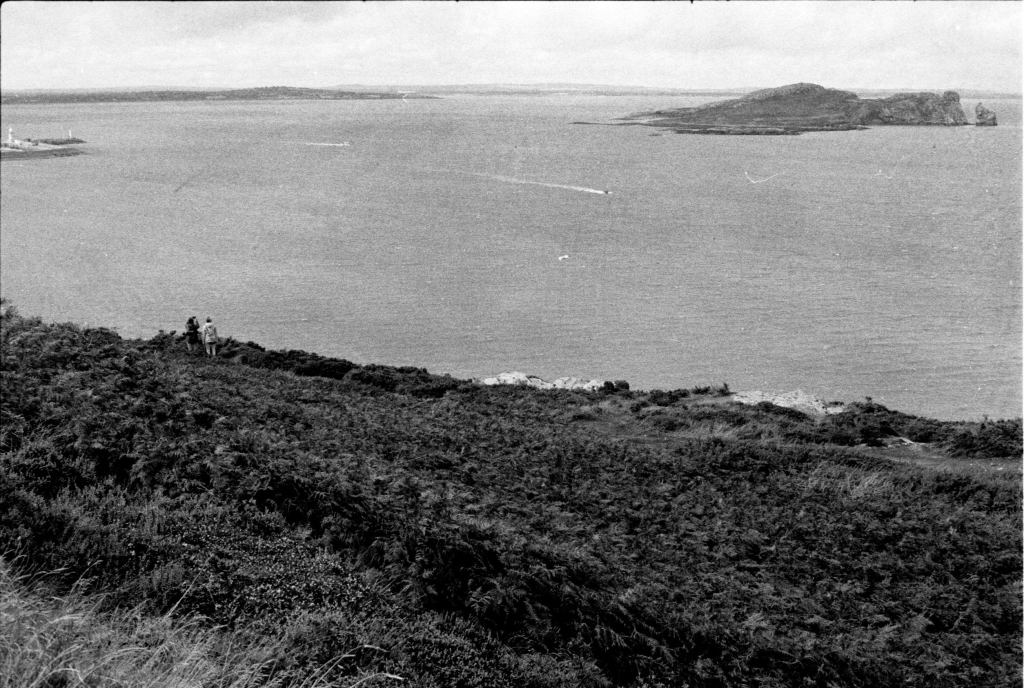
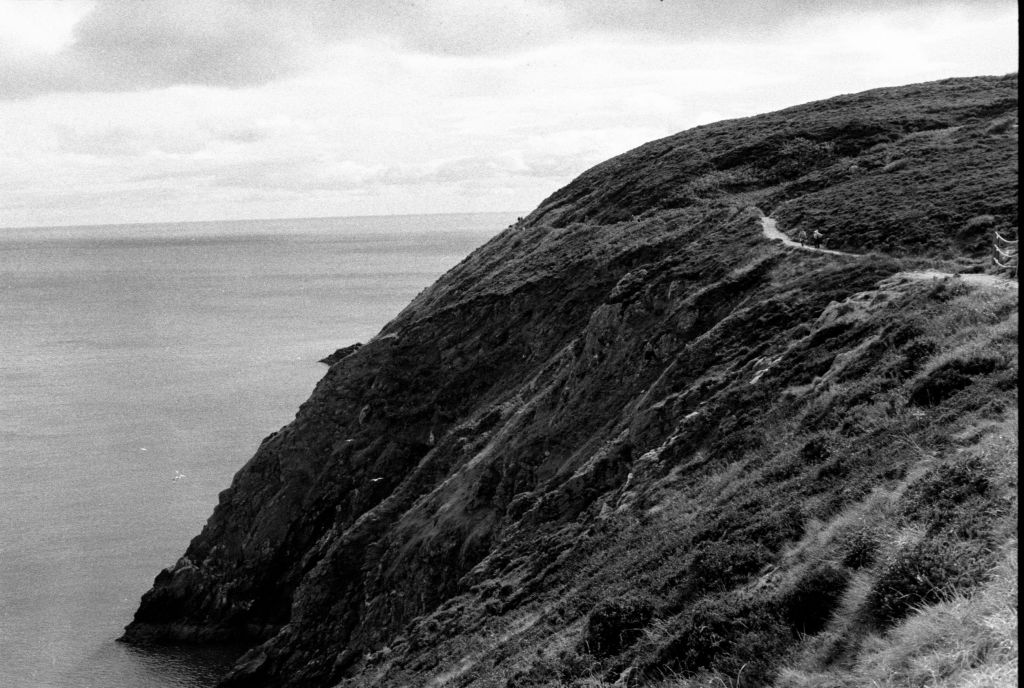
The northern boundary of Dublin Bay is a peninsula that juts prominently into the Irish Sea like an upraised chin. Relative to the shallow sprawl of the city, Howth is further distinguished by its elevation, rising 170m at the hill’s apex.1 While the south side of the peninsula slopes gradually through verdant estates and lush fields toward the sandy shores of Sutton Strand, the north side drops off dramatically. A popular walking trail traces the ridge where the coastline was long ago cleaved away. During the warmer months, a steady stream of tourists flock from Howth Station past a string of bustling storefronts and “chippers” (the popular fish & chips go-tos), to the marina, where seals poke their heads between yachts and fishing vessels. Before there were the crowds, there were the fishermen, and the heart of Howth still remains at sea level.
For years, Howth’s mild microclimate has made it a haven for native flora and fauna. The National Parks & Wildlife Service notes a distinct variation between Howth Head’s vegetation zones: sea cliff communities within the “Pioneer Zone” are to be distinguished from those in the “Maritime Slope Flush Zone.” You might ask, what are these zones, and who named them? and I will tell you that I do not know, and whoever did had a lot of fun with it.2 Environmentalists are not alone in their appreciation of Howth’s greenery. James Joyce, in his Ulysses, writes of wild ferns and rhododendrons, shading Leopold’s picnic with Molly on the Howth hilltop – the nature of that peninsula is steeped in poetry.
Throughout the year, Howth is home to a stable population of more than 8,000 residents. Given their adoration for the land’s natural beauty, it is no wonder that locals have worked hard to preserve it. In lieu of more roads, a network of paths connect the town to the hilltop, bypassing large swaths of vegetation and creating space for breeding colonies of gulls, guillemots, and razorbills. Not far away, on North Bull Island and Ireland’s Eye, protected areas give way to puffins, gannets, kittiwakes, guillemots, and shags.3
The importance of greenery in Howth has long extended to the backyards of its inhabitants. Gardens have been a staple of life on the peninsula since the Norman Baron of Howth, Almeric St. Lawrence first built Howth Castle in 1180, overlooking the harbor. While it is unclear when the first bulbs were planted on the estate, the mid-19th century saw the creation of the large rhododendron garden that is still enjoyed by visitors today. The beech hedges standing at the castle are some of the oldest in Ireland, planted in 1710.
If you were to walk the path from the harbor to the hilltop, you would be spat out not far from Ardan Garden, where I volunteer every week or so alongside its owners, Conall and Nuala. During my time at Ardan, I have been struck by the role of gardening in reinforcing community and neighborliness. This aspect is what I will focus on for the rest of this piece.
II.
I was out in the garden once, admiring the shimmer of a silver dollar plant (Lunaria annua), when Conall gave me a little nugget of historical context for it all. He enlightened me to the fact that the vast majority of the Howth hillside used to be English Protestant, and that Irish Catholics only arrived relatively recently. During the many long years of Protestant landlordism and Gaelic dispossession, Catholic Irish were largely stripped of ownership of fertile lands, a process that was formalized in the 18th and 19th centuries through the Land Acts.4 Now, gardening takes time. It requires patience and energy and attention, and for much of Irish history, many Catholics had little to spare. The effect of this historic inequality is that gardening on the Emerald Isle has largely been molded by and for its Protestant English population. And so in Howth, as Irish Catholics have regained land and political power, they have continued the long tradition of gardening.
With the acceptance of gardening, however, has come the rejection of the old English methods, with their emphasis on order and formality. In its place, Irish gardeners like Nuala and Conall have embraced a naturalistic, lush aesthetic, tailored to the land’s moist climate. They have brought in exotic, tropical species to flourish alongside native flora, in a sprawling yet free-flowing spread of dazzling color and beauty. It is hard not to see the rejection of order, of confinement, as the defiant redefinition of what was a tool of oppression.
Howth’s gardeners, from what I have seen and heard, form a relatively close community. The Howth & Sutton Horticultural Society, formed in 1943, offers resources and events for gardeners on the peninsula.5 Through their plants and projects, Howth’s gardeners not only connect with the land, but connect with one another. Their shared enthusiasm is palpable. Every gardener works under the same temporal and meteorological constraints, timing their propagations and plantings for spring and summer blooms.
I hold the general opinion that, in much of my home country, good ol’ America, the nation suffers from a serious lack of neighborliness. Our means of living and connection have grown to meet the ideals of a stark individualism. Our neighborhoods are not built with neighborliness in mind: they are built for coming and going, for passing by, for staying put. It is an easy thing to live surrounded by others and not see a soul. The world is in desperate need of neighborliness. Neighborliness against division.
And so, the humble hobby of gardening. Gardening gives an impetus for interpersonal connection. In Howth, gardeners will visit each others’ homes, if only to compare plants or get new ideas. It is even common practice to bring on one’s visit an interesting flower from your own garden, and to leave with a new addition for yourself. This sort of plant swapping and gifting is a form of exchange that not only strengthens neighborly bonds, but encourages gardeners to visit again and again. A visiting gardener might point to a particular peony or rose and say “Where’d you find that?” and the owner will say “So-and-so gifted me it.” And like so, another gardener is clued into the neighborly web of green-thumbed do-gooders.
This has all been rather long-winded, but if I were to add some sort of formal conclusion to this think piece, I would say this: gardening can be many things. It can be used to divide and oppress people, to keep people down. At its best, though, gardening can be a means of uplifting oneself – a tool of connection and liberation. In Howth, Irish gardeners are realizing a vision of their own creation, shaped by their own ideals, cultivated by their own hands and rooted in windswept Irish soil.
- Howth and Its Heritage. n.d. Accessed January 8, 2026. http://www.howthheritage.com/howthanditsheritage.html.
↩︎ - Howth Head SAC: Conservation objectives supporting document. December 2016. NPWS. Accessed January 8, 2026. ↩︎
- forestfriendsresources. 2021. “Nature Conservation in Howth.” Forest Friends Ireland, August 3. https://forestfriends.ie/2021/08/03/nature-conservation-in-howth/.
↩︎ - Ireland’s Land Acts and the Decline of the “Big House.” 2023. June 18. https://www.bbc.com/news/uk-northern-ireland-65684388.
↩︎ - “Howth & Sutton Horticultural Society.” n.d. Accessed January 8, 2026. https://hshs.ie/.
↩︎
 charlie deichman-caswell