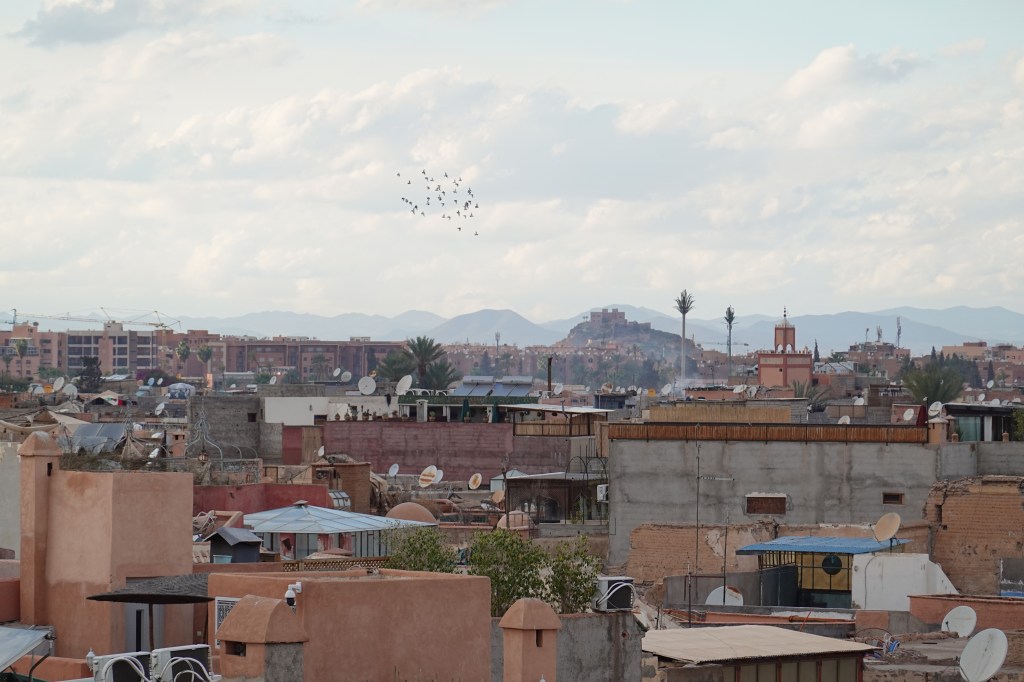
Friday, February 21: Marrakech
As the plane touched down in sunburnt Marrakech, I felt my chest tighten with a familiar and not unwelcome uncertainty. I had missed that feeling, that nervous fluttering and restless urge to disembark and rest your feet on hot tarmac. Peeling off my jacket, I felt the dry heat of the midday sun on my forearms. The swaying of palm trees, the rigid smile of the flight attendant waving us toward customs, the snowcapped High Atlas Mountains stood resolutely to the south.
Approaching the window of my taxi, a man on a motorcycle, riding fast. Stood in front of him, his young daughter, her hands gripping the inner handlebars. Both, helmet-less, smiling from ear to ear. I watched these scenes pass me by. Red, mud-brick homes; pack mules carrying bananas and dates and plastic water bottles; Chinese Docker bikes weaving through traffic like darting serpents. One week later, these sights would be unremarkable, commonplace. For the moment everything was new. I met Ben at our hotel, a tastefully decorated riad with a lush inner courtyard, whitewashed walls and a rooftop terrace. He was jet lagged but energetic and we took a cup of Morocco’s emblematic mint tea before slipping into the swarming labyrinth of the Marrakech Medina.
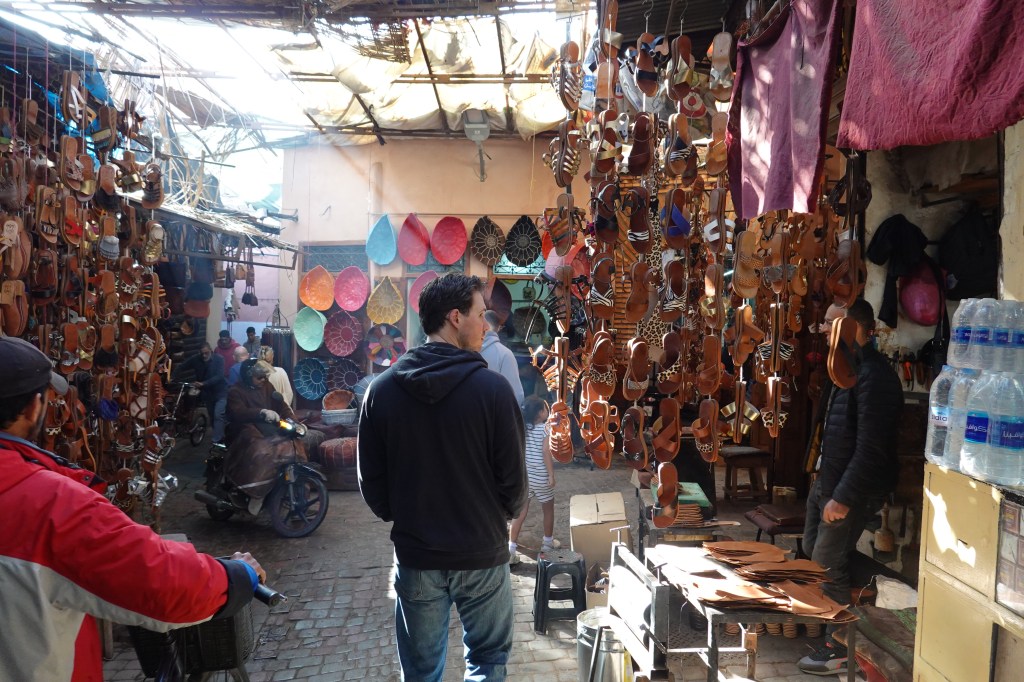
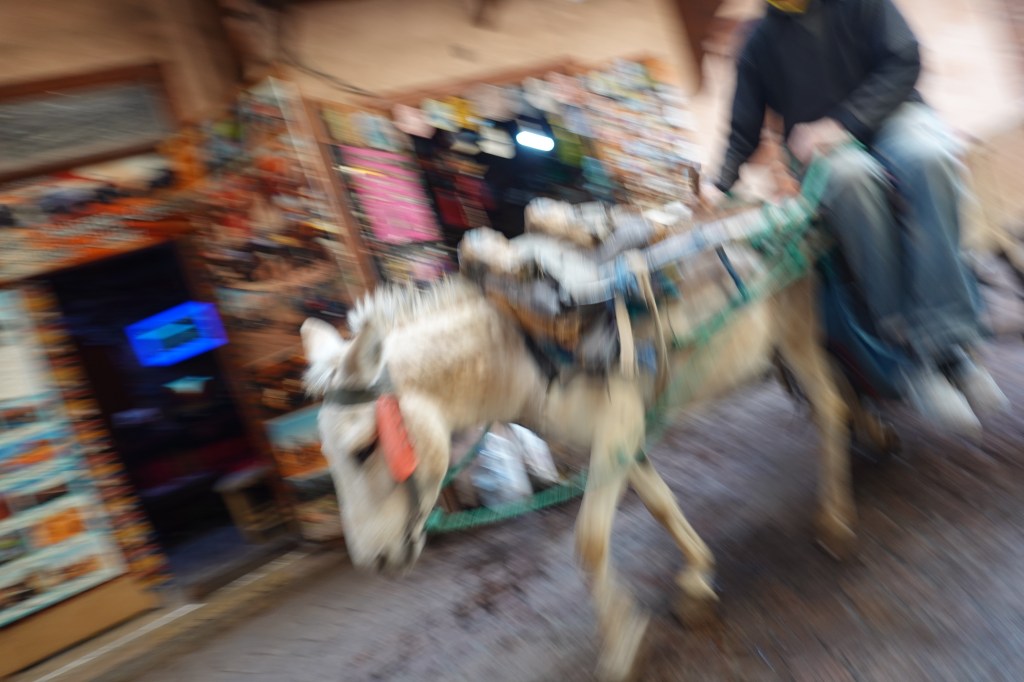
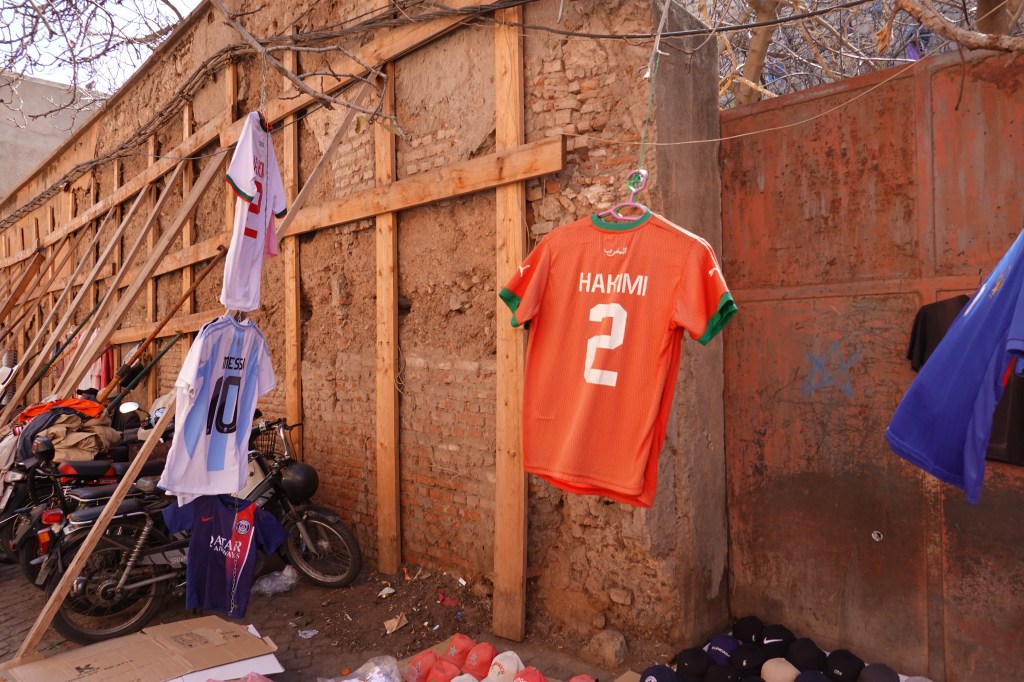
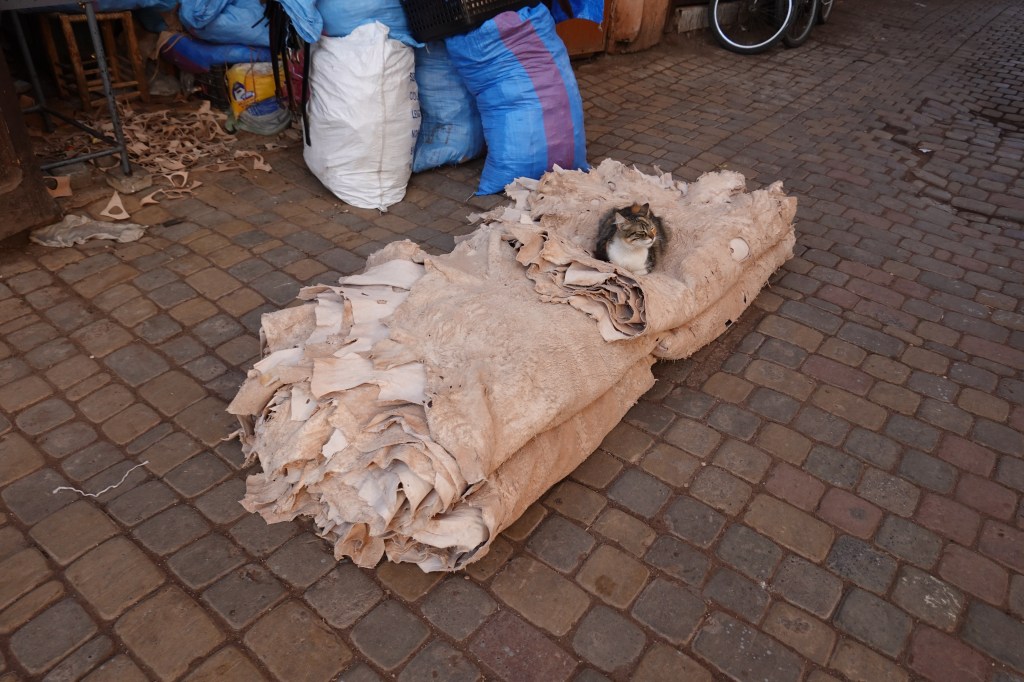
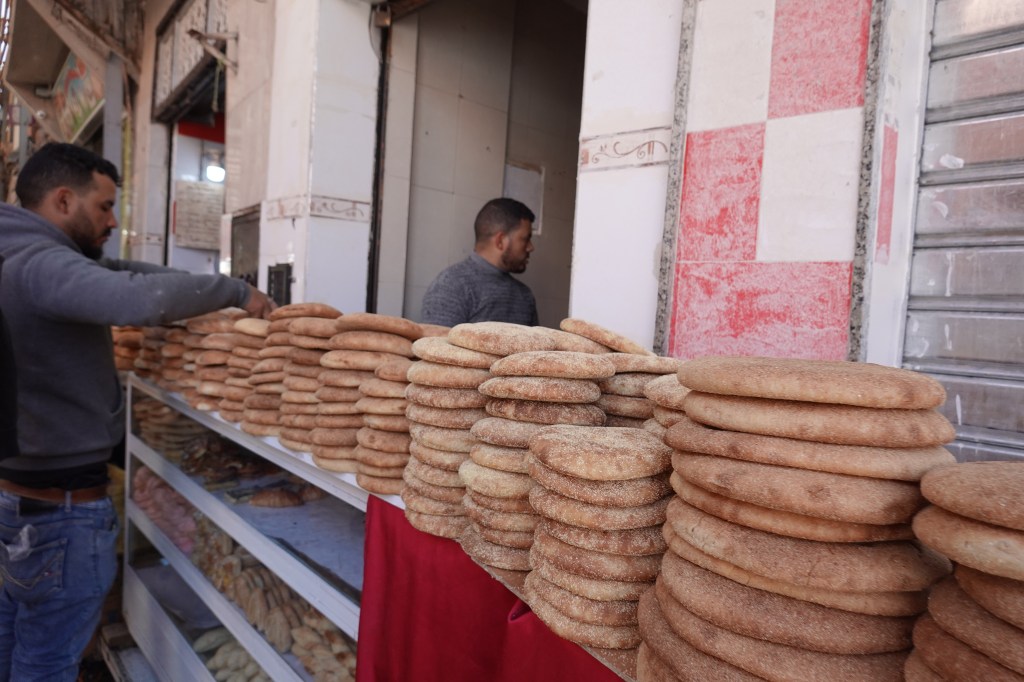
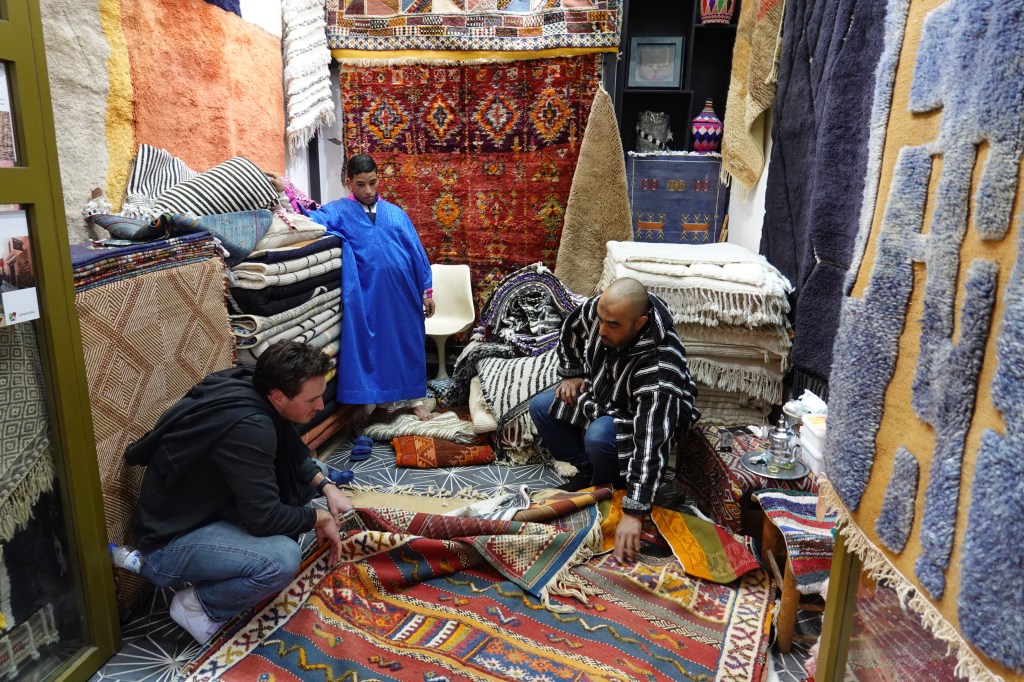
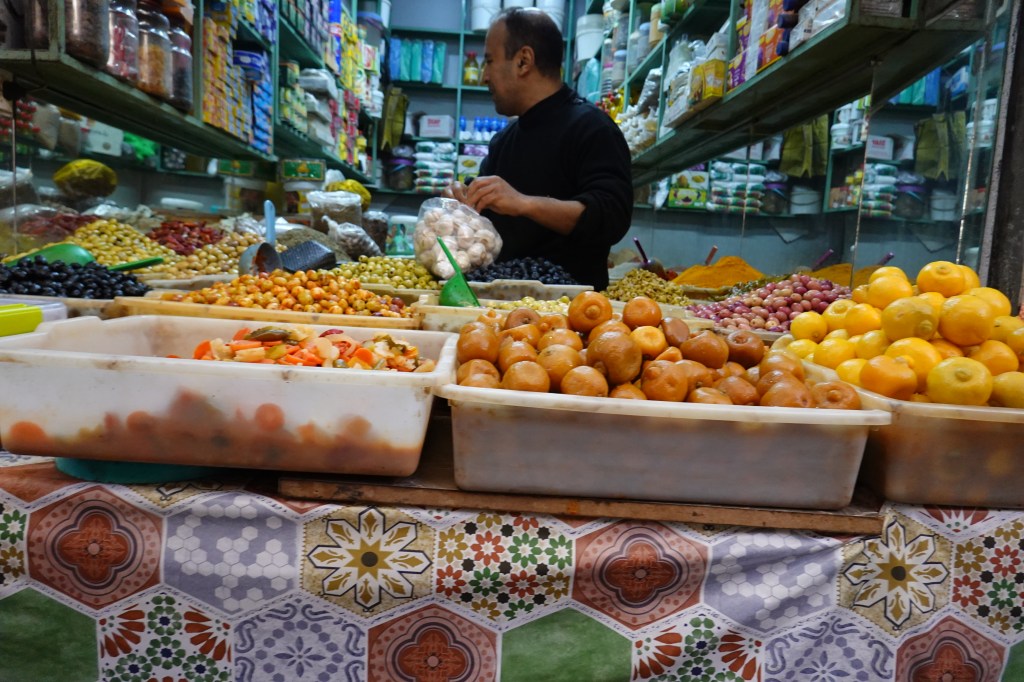
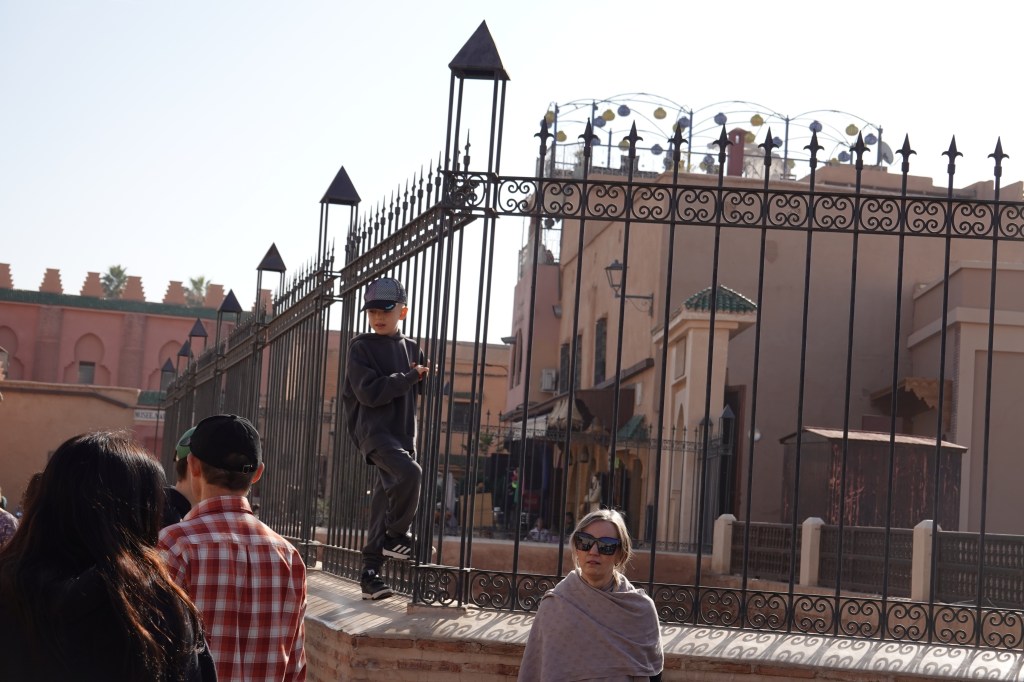
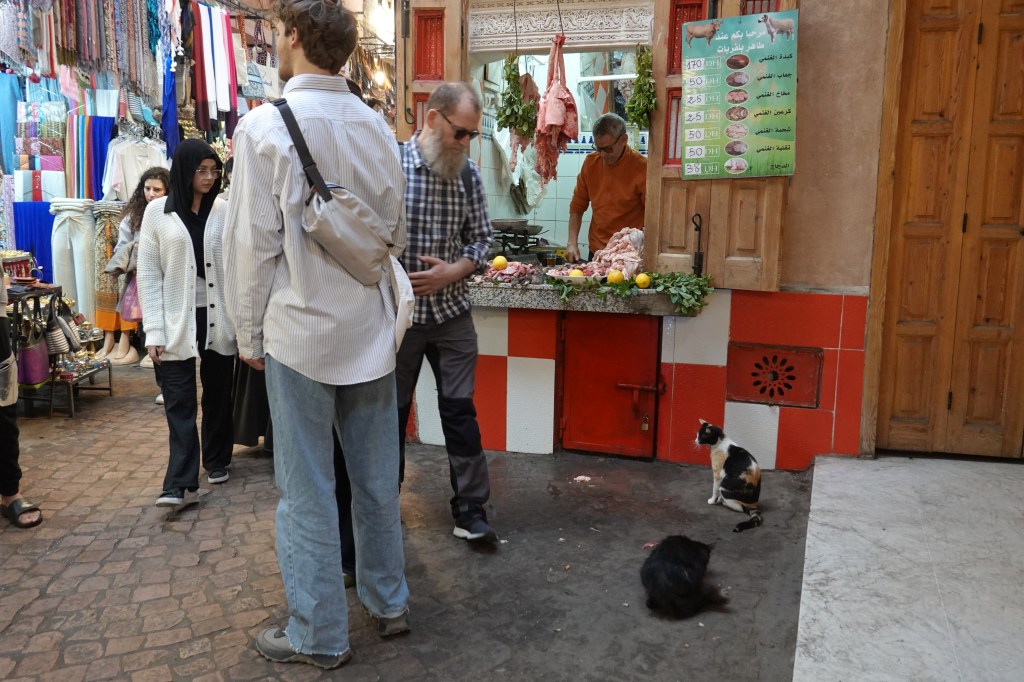
In describing the Medina, it’s hard to avoid likening that swelling market to a living thing. It screams, it barks, it murmurs and at night it hums insistently. Like a hungry organism it swallows, reshuffles and steers those who pass through its 19 gates, guiding them past the heart of Jemaa El Fna and into the souks, Marrakech’s churning stomach. We traced this path from back to front, from our riad near Madrasa Ben Youssef to Jemaa El Fna, hunting for grub. The square is large and imposing, crowded with stalls of fruitsellers selling sugarcane juice, snake-charmers, tourists, and “handlers” peddling glimpses at screaming monkeys with iron collars.
At the core of Jemaa El Fna is a grid of restaurant stalls, each equipped with a team of advertisers, tasked with wrangling tourists toward their stall. These men have memorized their universally-underwhelming sales pitches, each parroting the same words as the next. “Don’t panic, it’s organic!” touts one, followed by a parade of “Best quality!” and “For you, best price! Moroccan price!” We fended off the salesmen as best we could, though they would physically insert themselves in our path or grab onto us with their hands, as though we were thrown into a pond of leeches. Finally we stopped at a stall, where we heard the salesman saying “Honestly, it is all the same thing. We all just want business, and it is all good.” The food was good – kebabs of chicken and vegetables and lamb, and a decent harira soup (a tomato-based soup with chickpeas and other legumes, served before most meals) – and as we walked away, through the parade of salesmen, we heard iterations of the same spiel that had won our business.
Saturday, February 22: Marrakech
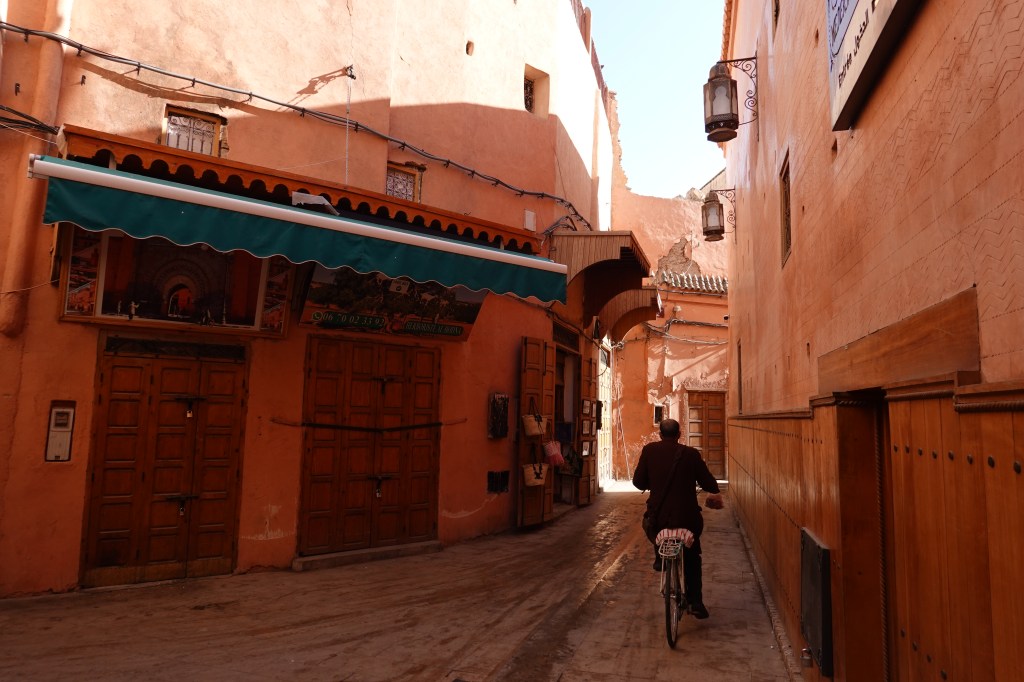
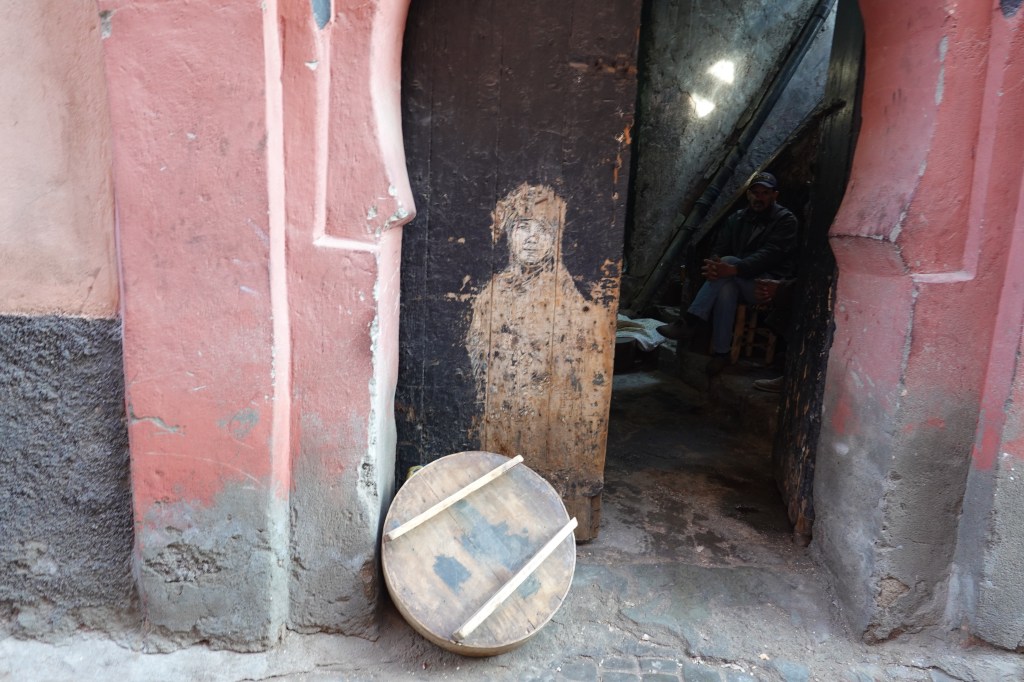
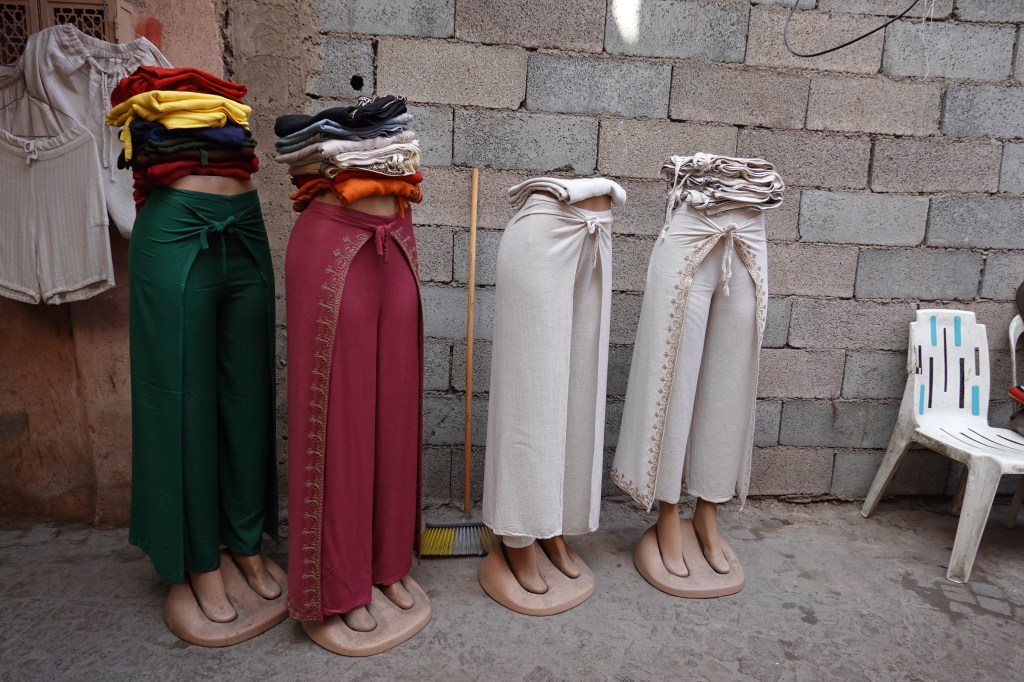
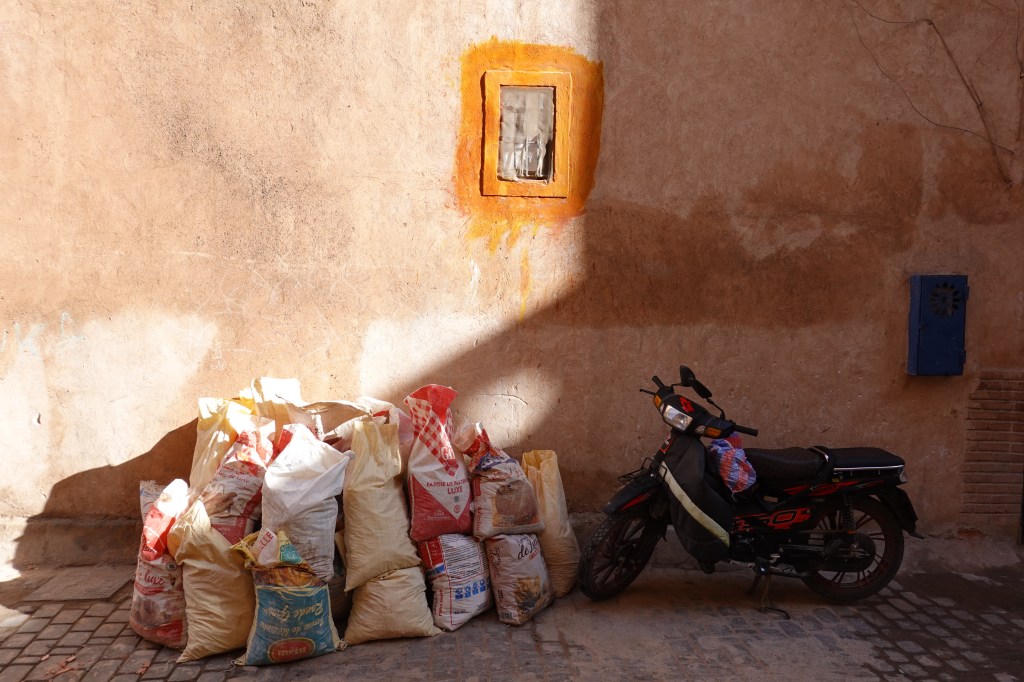

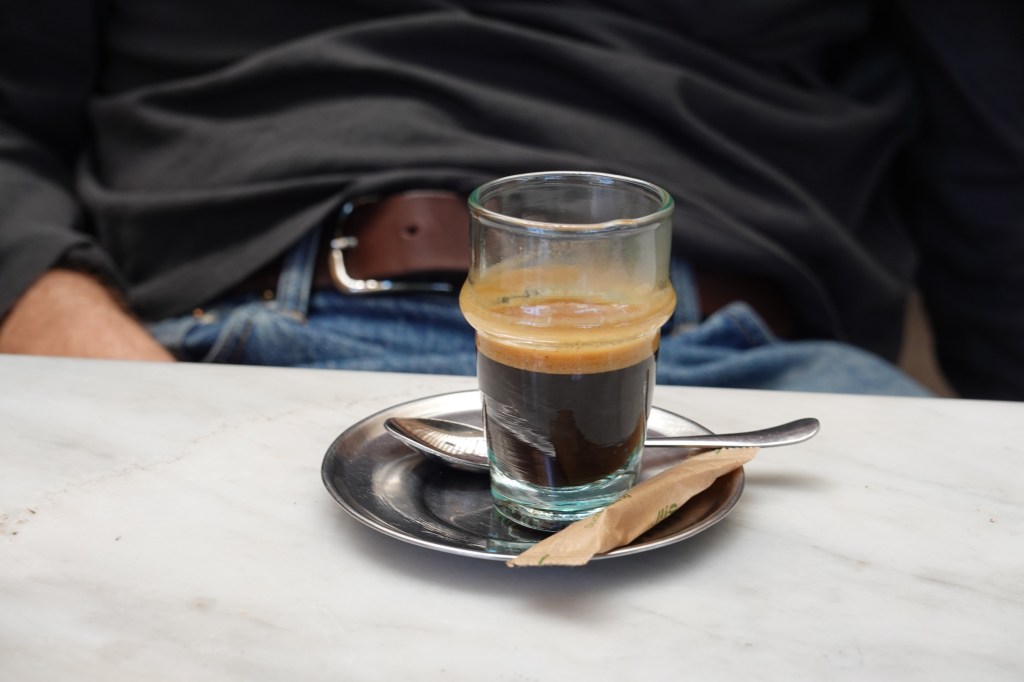
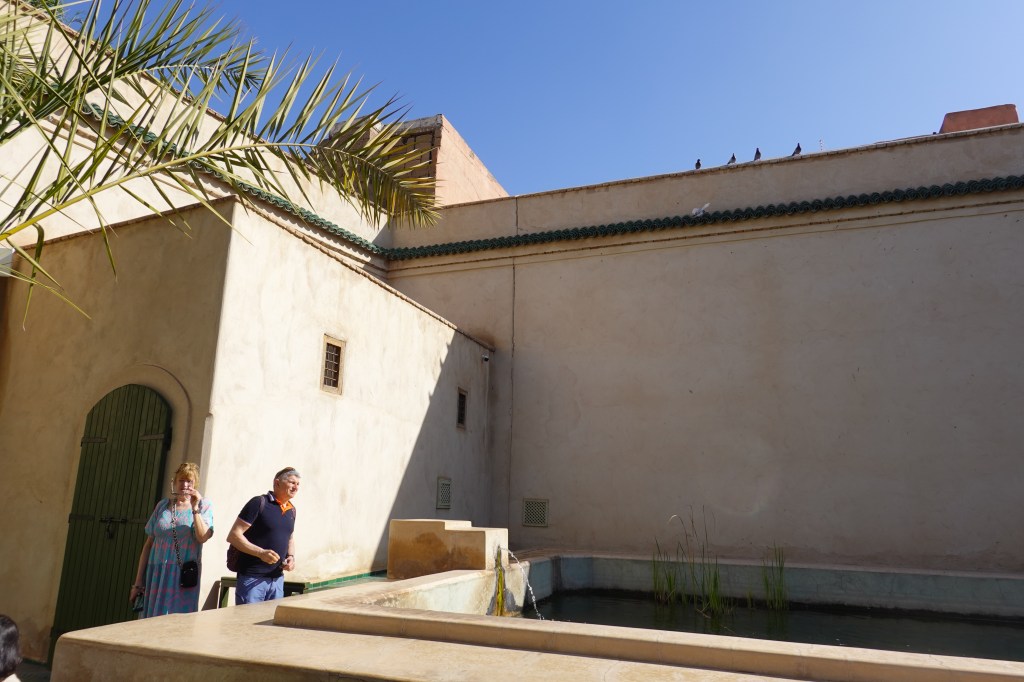
We spent our first full day by wandering, starting with a visit to the Madrasa Ben Youssef, a puzzling complex lined with small students’ quarters, and at its core a dazzling water feature. From the Madrasa we dipped into the Jardin Secret. The Jardin is a large walled oasis and boasts exotic species of plants from Marrakech-adjacent climates. Ben occupied himself by studying the space’s water circulation system and the centuries-old plumbing that moves water throughout the garden. When he was finished with his nerd-shit, we kept on with our favorite pastime: aimless walking, interrupted by the occasional bite. We visited a temporary exhibit in the Maison de la Photographie, about the development of black-and-white film photography practices in Marrakech, paralleled by the growth of the city itself. We gazed from the rooftop at the High Atlas Mountains, drinking mint tea. The sun illuminated the side of a spine-like ridge to the south. We kept walking and in the evening we got thirsty.
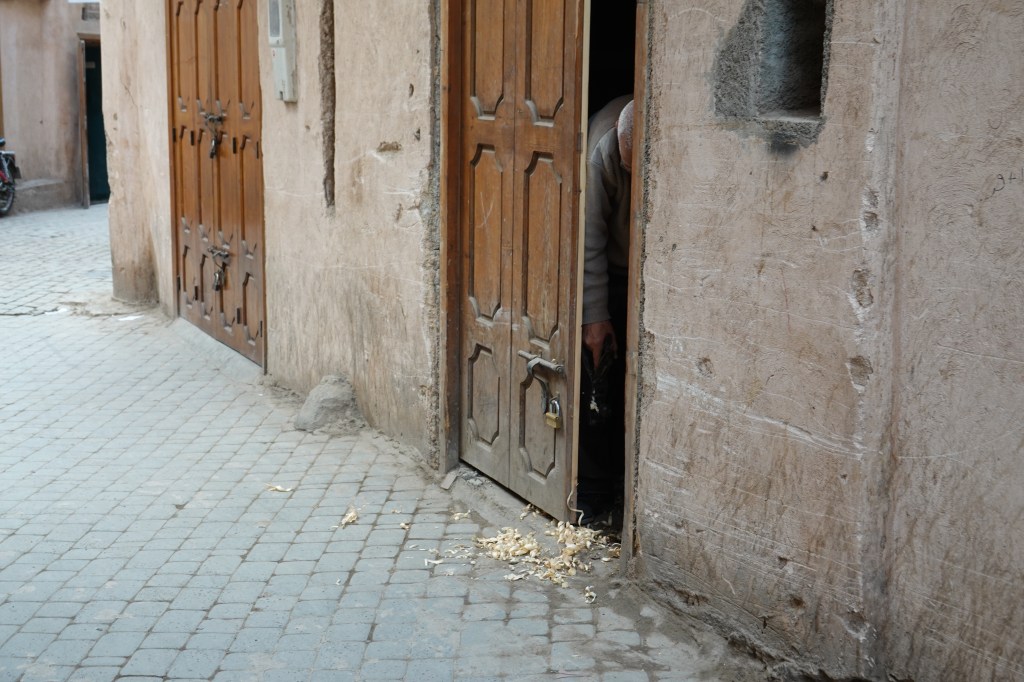
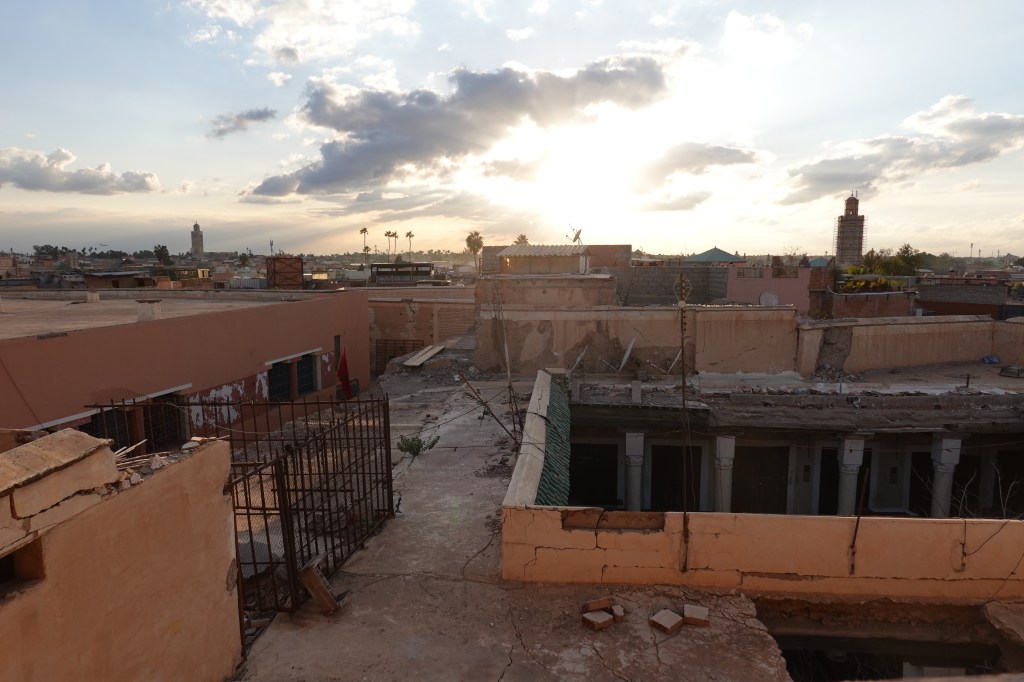
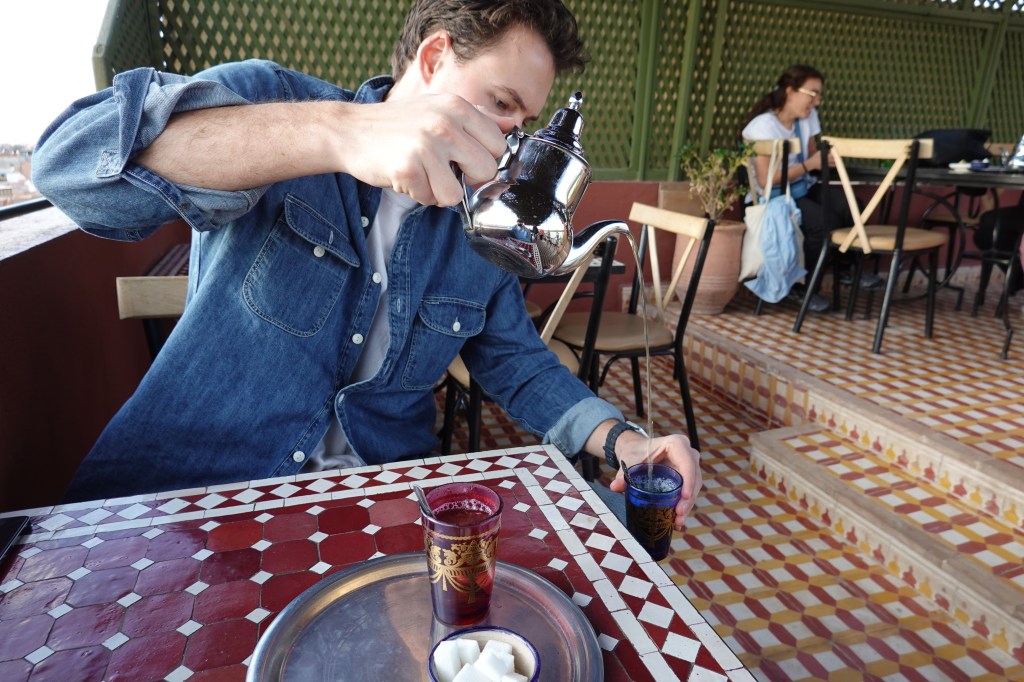
“I’m thirsty,” I say, half to myself.
“Do you want to get a … tea?” We had had two teas that day.
“What about a … uhh …”
“… yeah.”
The beer was crisp, from a Moroccan brewery. We had hoped for a terrace, but settled for a speak-easyish too-quiet salon in the souks. A soccer match was projected on the wall and clusters of men and women, their faces drawn downwards as if controlled by a four-fingered puppeteer, smoked long clouds over their shoulders. We finished our drinks and left. By sundown we found ourselves on a terrace, enjoying traditional Moroccan fare and people-watching in the nearby square. We slept deeply.
Sunday, February 23: Marrakech to Sti Fadma
In fact, I felt as though I had gotten an extra hour of sleep. My phone read 9AM and my watch told me 10AM. I was suspicious, and I watched as our host frantically paced around the riad before approaching with a tray of pastries.
“Hello,” I nodded.
“Hello.”
“I hope that we’re not too late for breakfast.”
“No. Um. Maybe. Breakfast is served until 10AM. I read something in the news this morning. It is either 9:30AM or 10:30AM. I need to be sure of what time it is. Thank you.”
A moment later.
“Hello. I was correct. It is 9:30AM. Yes, you may have breakfast.”
He explained that, in preparation for Ramadan, King Mohammed VI had ordered that the clocks be set back one hour. This happens every year and every year it is, apparently, equally confusing. When Ben stepped out from our room he asked about breakfast and I explained the situation to him. The king had given us an hour of sleep, and we gave a quick nod of appreciation to the portrait on the wall.
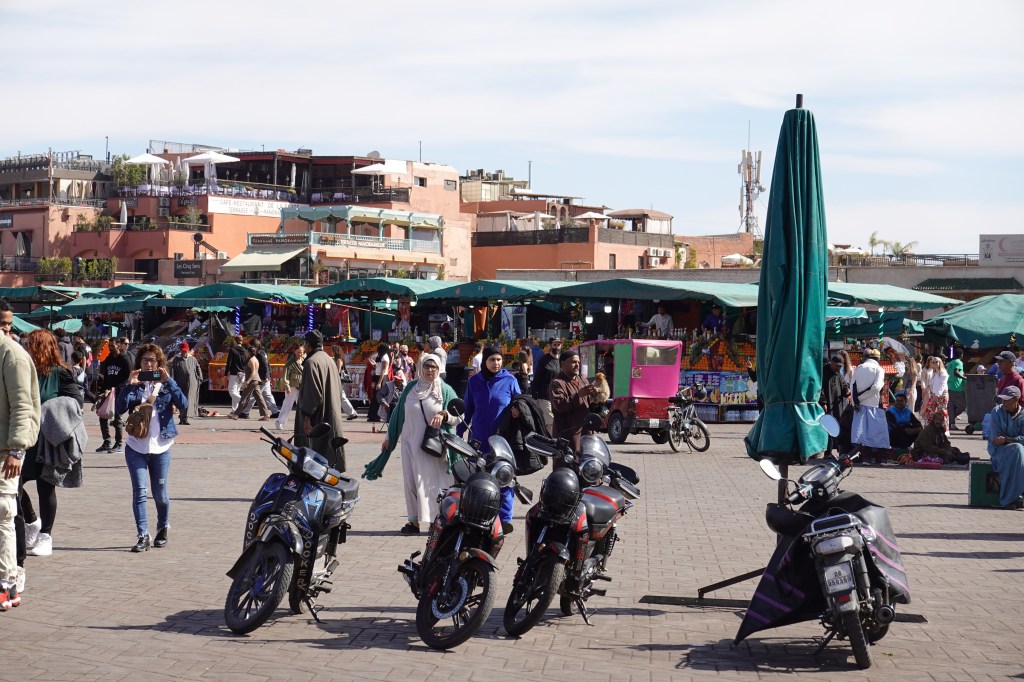
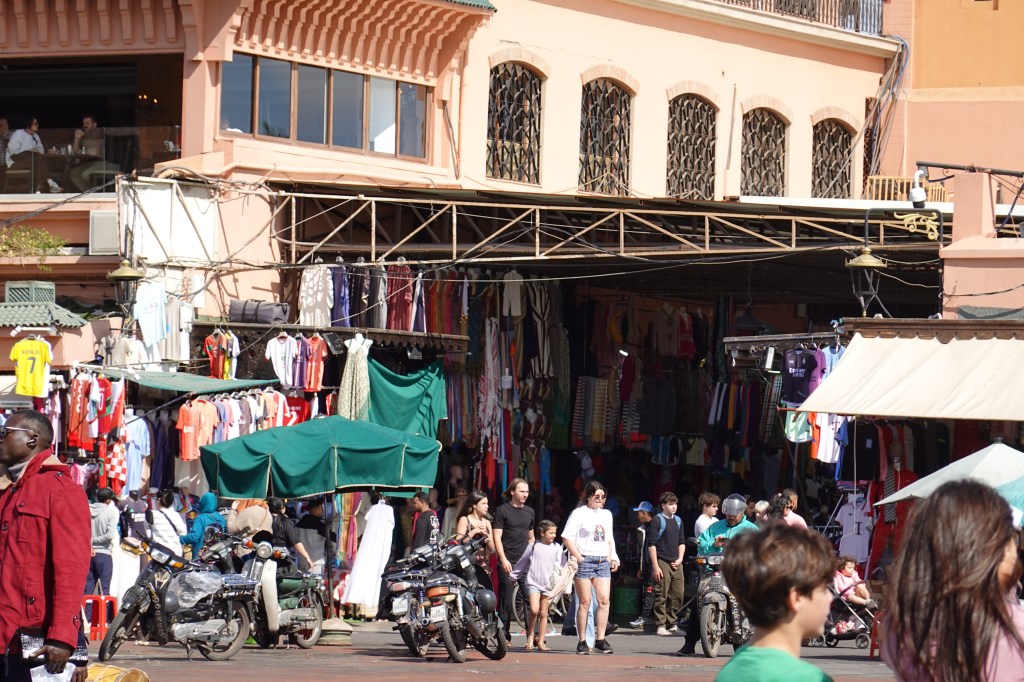
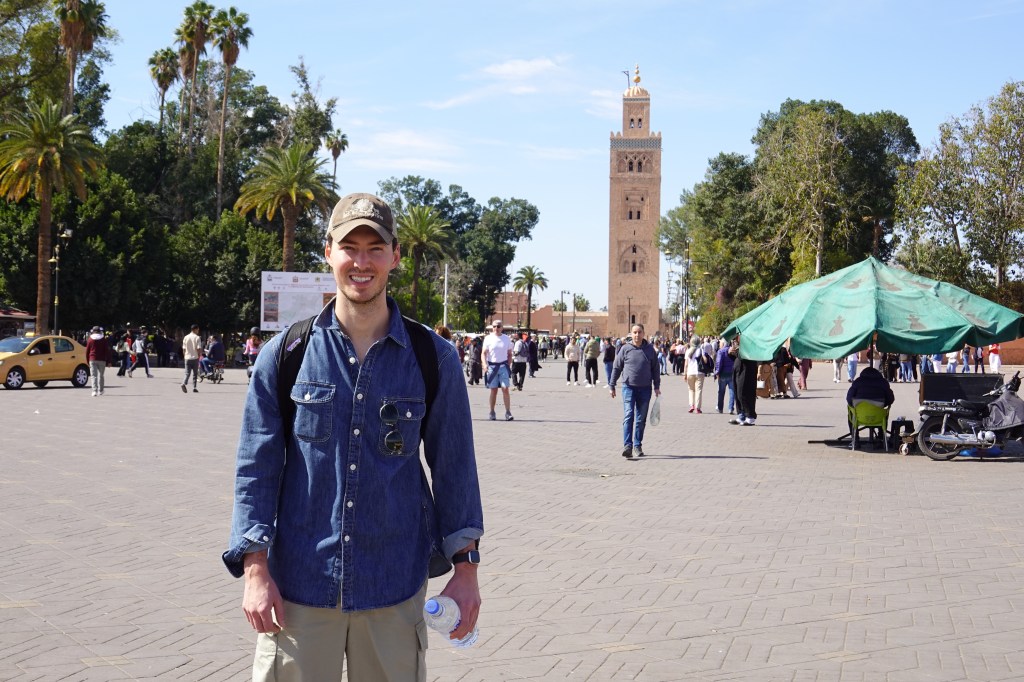


We trekked through the Medina, bags in hand, until we were spat out in Jemaa El Fna square. It was a quiet morning by Marrakech’s standards, and we surveyed the market’s bizarre core before hailing a taxi to take us to … a bigger taxi, eventually dumping us deep in the High Atlas Mountains. In Morocco, small taxis (literally, “petit-taxis”) operate within cities and smaller metropolitan areas. Outside the city limits, “grand-taxis” transport people from city to city, generally as far as you’d like. The cost of the trip is calculated at the beginning and it is expected that other riders will arrive to split the price. If a rider doesn’t want to wait, then they can pay the price for multiple seats. The taxi was large and comfortable. Ben was grateful, though shocked, not to be crammed into a small Mercedes van, forced to straddle the gearstick – a real possibility, he will tell you.
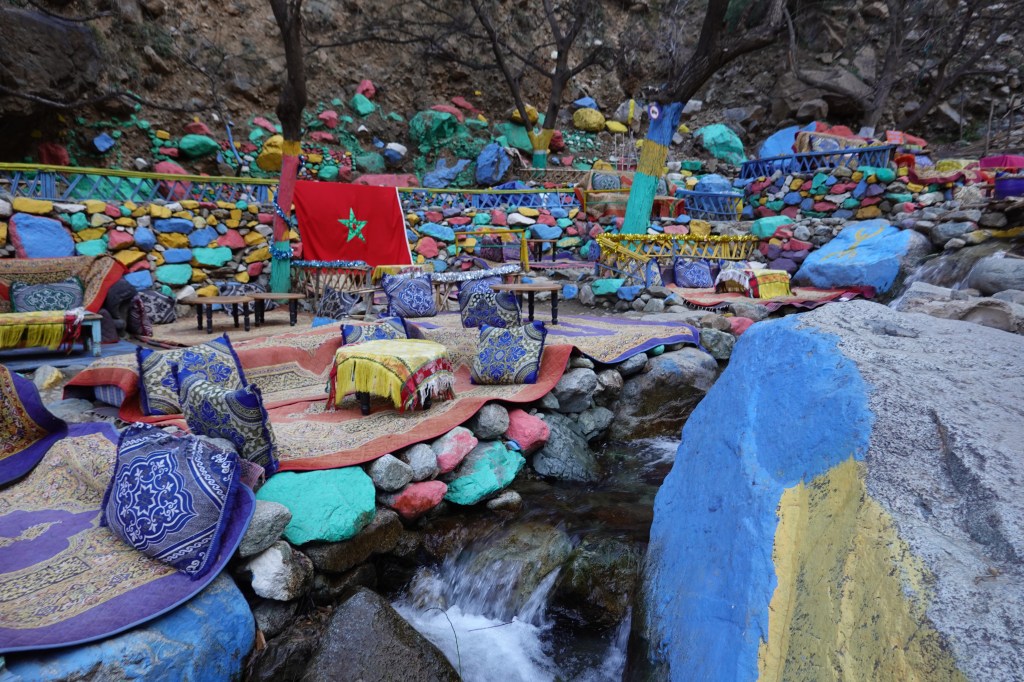
Leaving Marrakech, we entered a landscape of dusty fields, sparse vegetation and clusters of small homes. We read our books and the mountains crept closer, until we were swallowed by them, shielded from the horizon. We were cradled by the arid peaks, dusted with powdered sugar, and we meandered between pockets of green and colorful riverside cafés, vibrant as gemstones. Turning a bend we passed camels, decoratively dressed and posing for postcard photos. Despite the distance from Marrakech, the winding streets were soon congested with taxis, tour vans, and the sputtering motors of the Dockers. In my book, The Empusium by Olga Tokarczuk, the protagonist enters a mysterious mountain valley and is overtaken by healing properties of the dewy spring air. Upon opening the taxi door, I squinted at the midday light of the Ourika Valley and I breathed in a dry mixture of dust and vape smoke.
Sti Fadma is a small collection of shops and riverside café-restaurants lining the main road to the south. More dedicated travelers might plan a multi-day hiking excursion deeper into the High Atlas, if only to escape the buzz. Sti Fadma’s accessibility, only an hour’s drive from Marrakech, makes it a popular tourist destination. We sat at a restaurant for lunch. Cold mountain water rushed past us, fast and free, as though some great reward lay down in the valley. We ate quickly, covered in sun. Our Airbnb lay some 20 minutes down the road, and we marched with our bags. We would walk where it was easiest to see the oncoming traffic, sometimes running to the other side of the road before reaching a bend. Our accommodation was the second story of a rustic home, run by a man named Lhousseine, who kindly showed us our quarters before we walked back to Sti Fadma. Ten minutes into our stroll, we were able to hail a taxi. The traffic had eased and, arriving, we quickly arranged for a taxi to pick us up from our Airbnb the next morning, at 8AM, and stepped outside.
We were back in Sti Fadma to explore, and to hike to the valley’s famous waterfalls. If we expected a rugged outdoor adventure, we were disappointed. The trail was heavily marked and trafficked. Shops selling rugs and Chinese goods lined the path, and the waterfall itself, though impressive, was crowded with nicely-dressed tourists. We decided to walk further and met a shop owner who explained that there were six more waterfalls to be found along the path. It would take close to an hour to reach the next falls, though the sun was dipping beyond the peaks and it would be dark soon. Ben and I took 20 minutes to climb slightly higher, beyond the crowd of tourists, and glimpse the higher falls from a distance. From our perch, we could see gentle, trickling streams and a small pool, but our eyes were peeled for something more. Back at the Airbnb, Lhousseine had explained how the mountains had recently received their first snow in years, and how the vegetation had flourished in the damp air, attracting monkeys. Looking closely, we saw nothing. But, with unfocused eyes, small shapes darted along the cliffside, growing small hands and grasping at berry bushes before tumbling along again. Sometimes they would run through the river, leaving small footprints on the rock. We watched the monkeys for a while and walked into town.
A haiku about monkeys

scamper slick wet toes
strong branches yield beneath touch
half-eaten berries
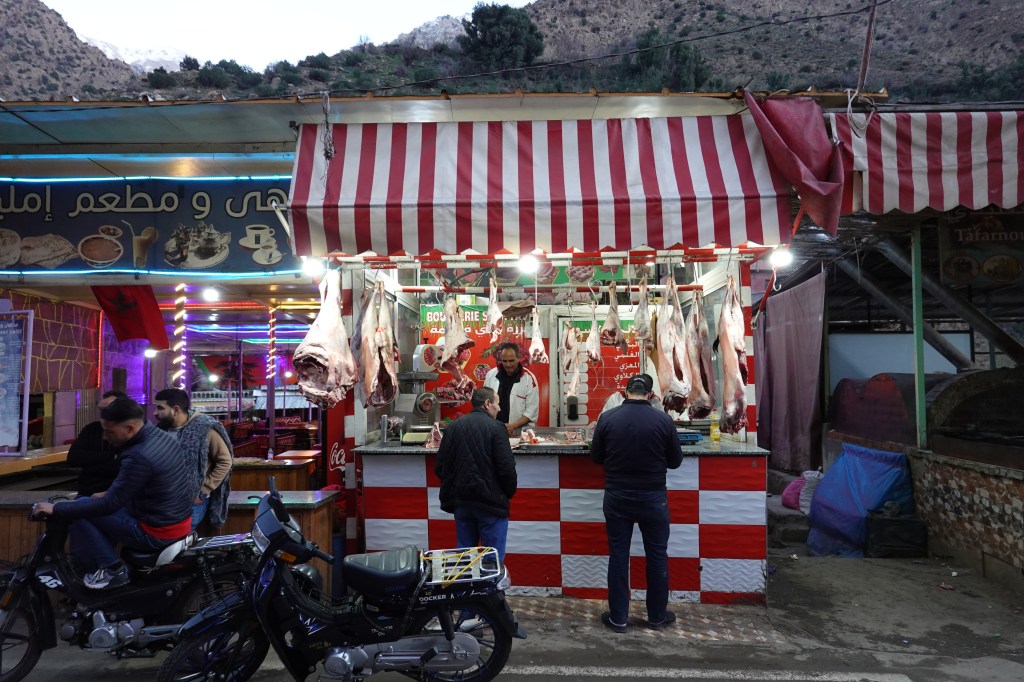

It was dark when we reached the village, and there was little to eat. The taxis had all gone back to Marrakech and Ourika. We bought some snacks and a sparkling apple juice drink, and we were attracted to a small sandwich shop – the only place that seemed to be serving hot food. We ordered paninis and watched the teenage employee piece together a sad sandwich of meat and veggies. The food was bleak, but we were hungry and we didn’t care. We accepted the sandwiches and walked, slowly, along the road to our Airbnb. There were not many cars, but visibility was poor and the few cars that passed us, passed quickly and violently. At Lhousseine’s home, he built us a fire and told us about his life in the mountains. He told us about hiking the tallest peaks in the High Atlas, and about his flock of thirty sheep. He told us about the rockslide that came and swept them away, and of the introduction of new technologies to the Amazigh and the Ourika Valley. He spoke to us as though he rarely took in guests, and I could hear him talking with Ben long after I had retired to my room. Sometime at night, Ben pulled me from my room and we watched the stars, gloriously unpolluted, blanketing the night sky.
Monday: Sti Fadma and Ourika to Rabat
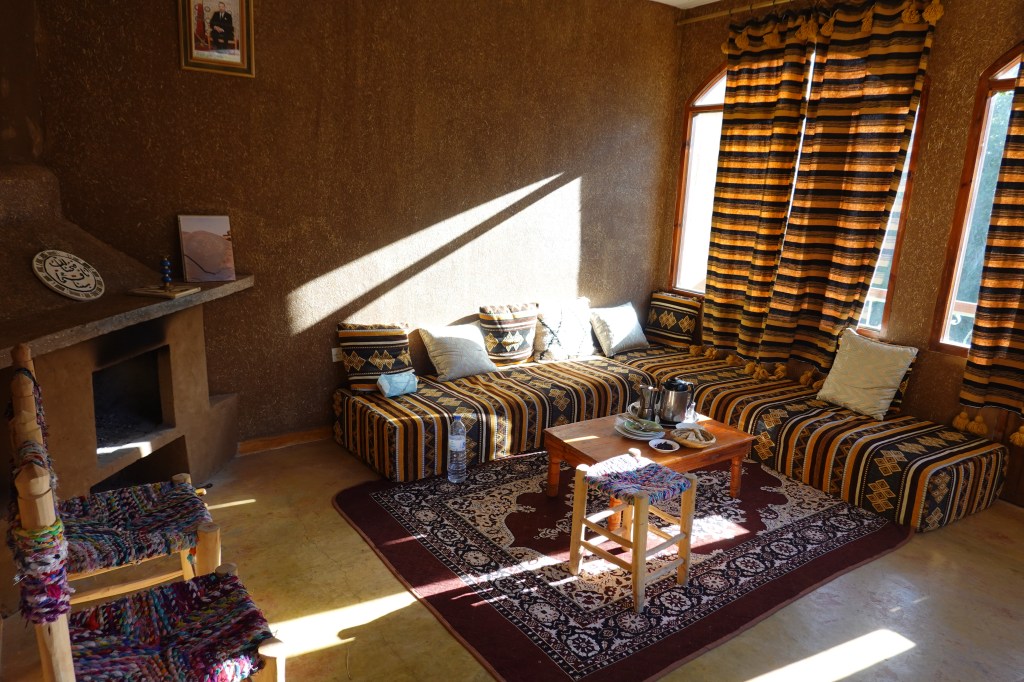


We woke at 7AM and Lhousseine greeted us with breakfast: tea, coffee, fresh blackberry compote, honey, a traditional flakey bread called msemmen, and butter, as he described it, “from a real Berber cow.” The morning sun shone through the room’s large windows, framing the outline of some giant mountain. I felt small. Our taxi came and we said goodbye to Lhousseine, and as we sped towards Ourika I was excited.
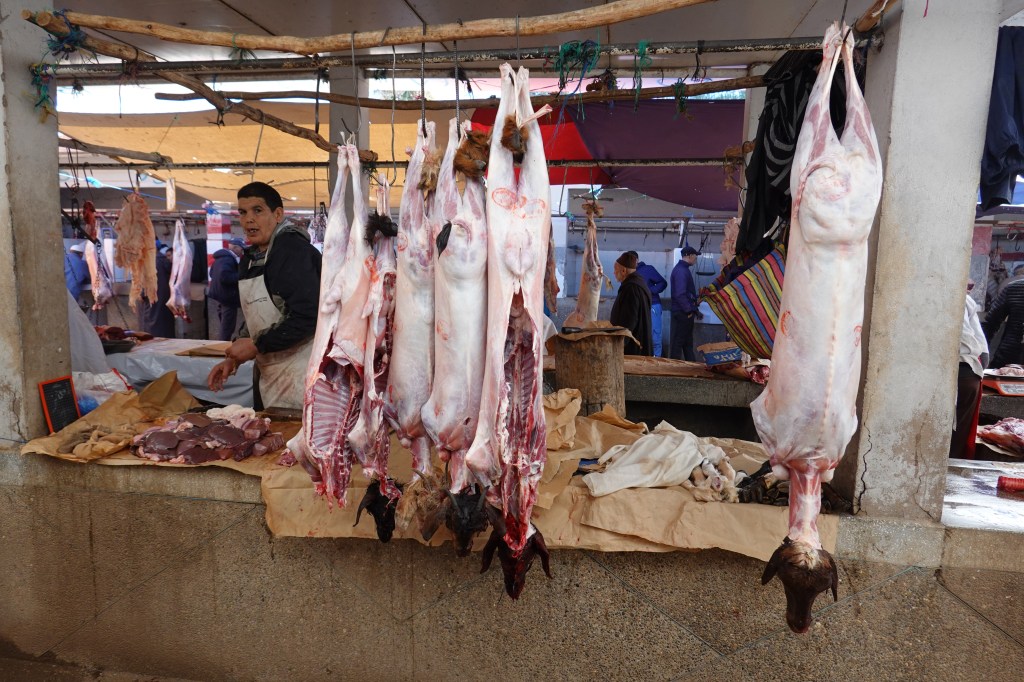
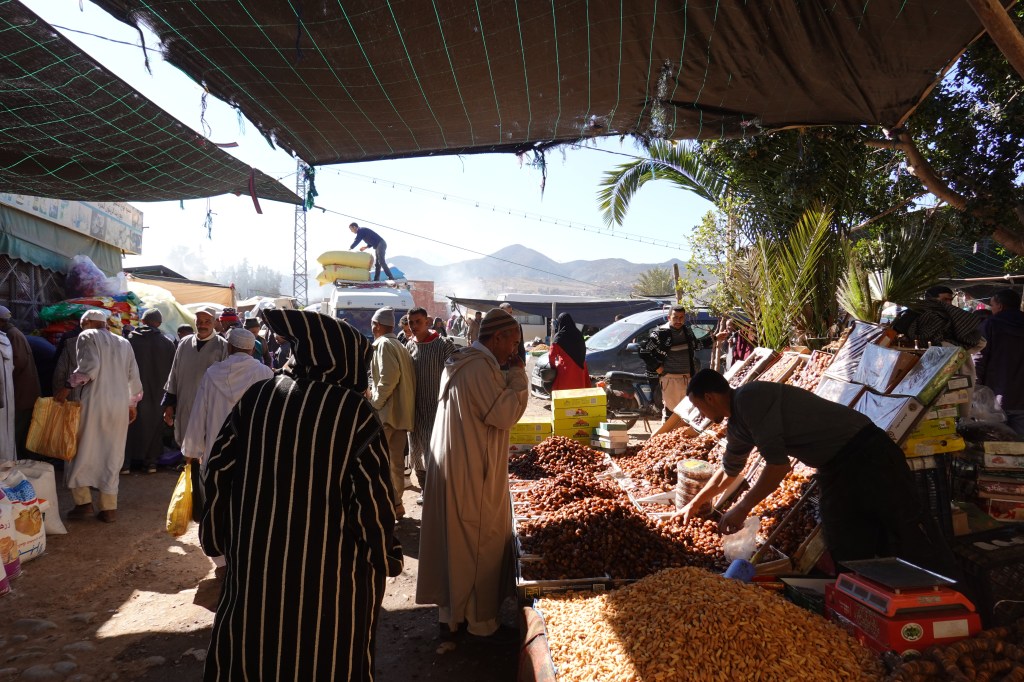
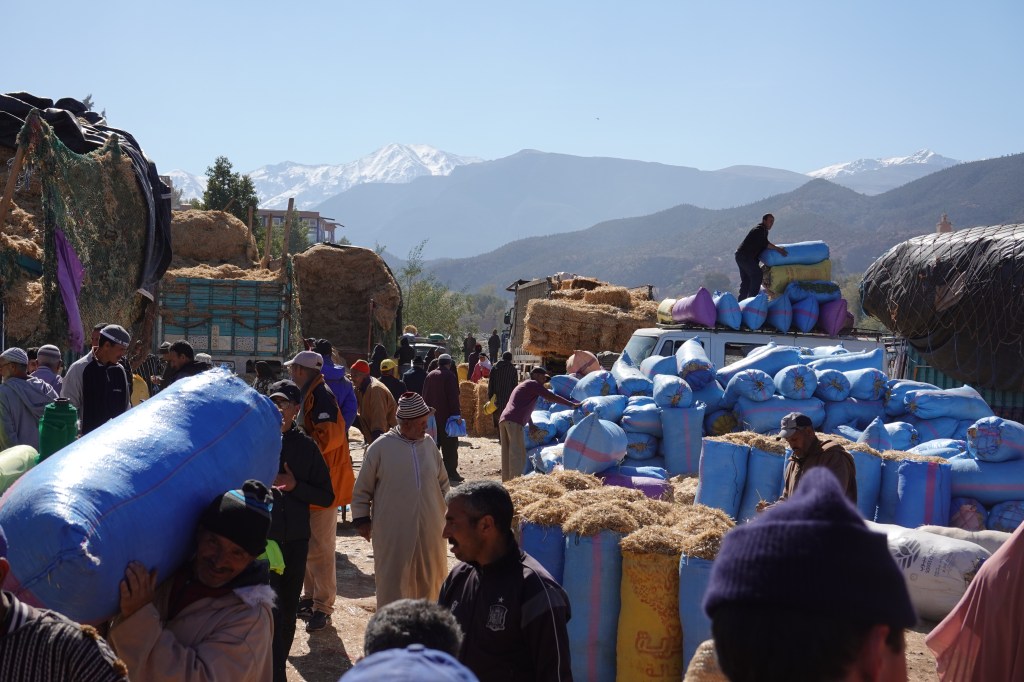
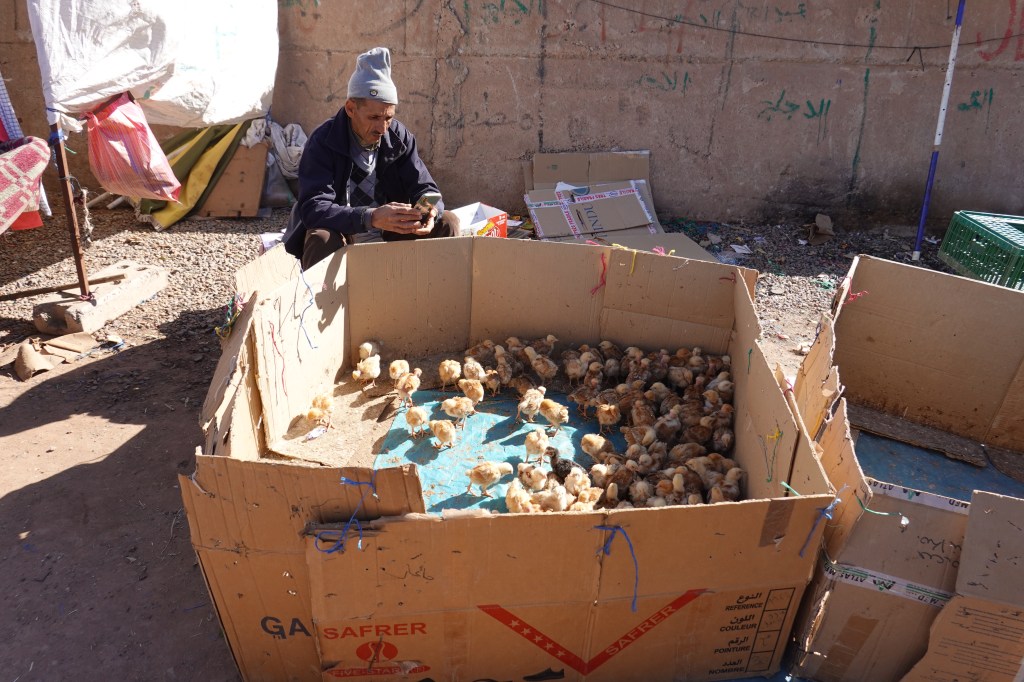
Ourika, at the foot of the Atlas Mountians, is a gateway between Marrakech and the High Atlas Amazigh communities. Every Monday morning, a large outdoor market takes place. Thousands of people come to Ourika to buy, sell, and trade goods. If it exists, you can likely find it at the Berber market – razors, washing machines, cellphones, textiles, motorcycles, hay, rabbits, beef. The labyrinth of market stands is constantly moving, shifting. Some vendors do not own stands, and instead sit in chairs by the road. Vendors are resourceful: a Coca-Cola bottle is used to hold peanut butter, or gasoline. A used pizza box doubles as a sunhat. Peeling my eyes from the fruit stands, I see a man holding a chicken upside down, a sheep auction, a child driving a Chinese motorcycle. Sheep heads, upside-down, on the floor of the slaughterhouse.
We struggled to catch a ride back to Marrakech. After a long wait, we were beat in a footrace to the oncoming taxi cars. We finally found two seats in the third arrival. From the taxi depot we walked through the New City of Marrakech to the train station, and in a fit of “hanger” we stopped at a French bistro. Salad, leafy greens, sweet relief.
On the train to Rabat we see a man in a long, brown djellaba, a nagging couple from Jersey, and miles of endless dust. I try to sleep, lulled by the steady tak tak tak of the railcar, of the frenchman next to me, of Ben, typing, of all things passing steadily by.

 charlie deichman-caswell